Reverse Mortgages
Turn your home equity into cash — with no monthly mortgage payment.
A reverse mortgage lets homeowners convert part of their home equity into usable cash without selling the home or taking on a monthly mortgage payment. The FHA-insured HECM serves homeowners 62 and older; the proprietary HomeSafe First (standard lien) and HomeSafe Second (second lien) options are available from age 55 — including for higher-value homes and borrowers who want to keep an existing low-rate first mortgage. The loan is repaid later — when the home is sold or refinanced, or when the last borrower moves out or passes away.
Key highlights
- HECM for homeowners 62 and older; HomeSafe options from 55
- No monthly mortgage payments
- Stay in your home and keep the title
- FHA-insured HECM plus proprietary HomeSafe First and Second
- HomeSafe First: more equity from higher-value homes, no FHA insurance
- HomeSafe Second: access equity from age 55 while keeping your low-rate first mortgage
- Lump sum, monthly payments, line of credit, or a mix
- Non-recourse — you never owe more than the home sells for
- Homeowners 62+ with significant equity
- Retirees who want extra monthly cash flow
- Homeowners who plan to age in place
HomeSafe Second — Keep Your First Mortgage
Access home equity without changing your existing first mortgage or adding a monthly mortgage payment. See eligibility and loan details in Warren’s flyer.
Open flyer PDF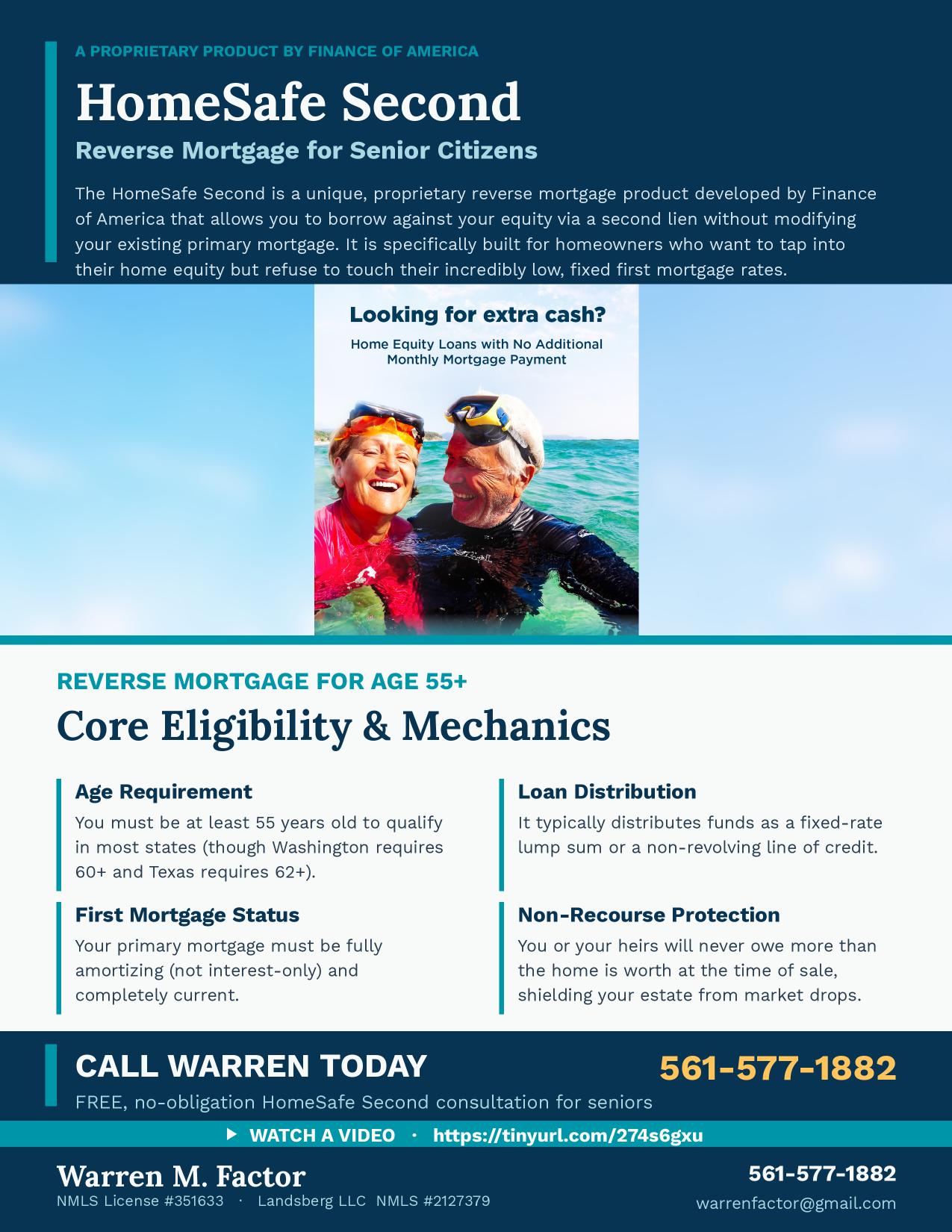
Flyer terms are subject to lender guidelines and individual eligibility. Age, credit, and payout options vary by HomeSafe product and state; the HomeSafe line of credit is available only in specific areas. Payout amounts, rates, and net proceeds require lender review — nothing here is financial or tax advice or a loan commitment.
What is a reverse mortgage?
A reverse mortgage is a loan available to homeowners aged 62 and older that converts part of the equity in their home into cash. Unlike a traditional mortgage, there is no monthly mortgage payment: interest and fees are added to the loan balance over time, and the full balance comes due when the home is sold, refinanced, or when the last remaining borrower moves out or passes away.
The most common reverse mortgage is the Home Equity Conversion Mortgage (HECM), insured by the Federal Housing Administration (FHA). Proprietary or jumbo reverse mortgages are also available for higher-value homes.
How a reverse mortgage works
- 01You borrow against your equity
The amount you can access depends mainly on the age of the youngest borrower, the home's value, current interest rates, and the FHA lending limits.
- 02No monthly mortgage payments
You continue to live in the home and keep the title. Interest and insurance charges accrue on the loan balance instead of being paid monthly.
- 03You keep up the home obligations
You remain responsible for property taxes, homeowners insurance, HOA dues where applicable, and home maintenance.
- 04The loan is settled later
When the home is sold or the last borrower permanently leaves, the loan balance — what you received plus accrued interest and fees — is repaid from the home's value. Remaining equity goes to you or your heirs.
Ways to receive the funds
Choose one payment option or combine several:
Take the full available amount at closing — often used to pay off an existing mortgage or cover a large expense.
Draw what you need, when you need it. Unused credit can grow over time, giving you a reserve for the future.
Receive a set amount every month for a fixed term or for as long as you live in the home — useful for supplementing retirement income.
Mix a line of credit with monthly payments to cover both planned and unexpected expenses.
What you need to qualify
Standard HECM requirements include:
- At least one borrower aged 62 or older.
- The home is your primary residence.
- Sufficient equity in the home.
- A session with a HUD-approved reverse mortgage counselor.
- A financial assessment showing you can keep up with taxes, insurance, and upkeep.
- The property meets FHA standards — single-family homes, FHA-approved condos, and certain manufactured and multi-family homes qualify.
HECM vs. HomeSafe First — which fits your home?
Choosing between a standard HECM (Home Equity Conversion Mortgage) and a HomeSafe First (standard lien) comes down to home value, age, and how you want to access your equity. While both allow homeowners to eliminate required monthly mortgage payments, they serve entirely different profiles.
On a $2,000,000 home, a HECM calculates borrowing capacity only up to the FHA cap — currently $1,249,125 — while HomeSafe First lets borrowers tap the full multi-million-dollar equity of high-value properties. HECMs carry high upfront Mortgage Insurance Premiums (MIP) that are added to the loan balance; HomeSafe First cuts out the FHA insurance fee entirely, which can save tens of thousands of dollars at closing on large estates — though proprietary jumbo loans generally carry slightly higher interest rates to compensate for the lack of federal backing. HomeSafe also opens the door for homeowners aged 55 to 61 who need to eliminate their mortgage payments but do not yet qualify for a standard HECM.
Key differences and trade-offs
- Home value and cap limits
- If a home is worth $2,000,000, a HECM calculates borrowing capacity only on the FHA cap of $1,249,125. HomeSafe First allows borrowers to tap into the full multi-million dollar equity of high-value properties.
- Upfront and ongoing costs
- HECMs carry high upfront Mortgage Insurance Premiums (MIP) that add to the loan balance. HomeSafe First cuts out the FHA insurance fee entirely — potentially saving tens of thousands of dollars at closing on large estates — but proprietary jumbo loans generally carry slightly higher interest rates to compensate for the lack of federal backing.
- Age requirements
- HomeSafe opens an option for homeowners aged 55 to 61 who need to eliminate their forward mortgage payments but do not yet qualify for a standard HECM.
HECM and HomeSafe First at a glance
The right choice depends mainly on your home's value, your age, and how you want to draw the funds:
Government-insured standard reverse mortgage for homeowners 62+. Borrowing capacity is capped at the FHA limit of $1,249,125, and high upfront MIP is added to the loan balance. HUD-approved counseling is required. Usually preferred when a flexible, growing line of credit is the primary goal and the home's value does not dictate a jumbo loan.
Proprietary, non-FHA reverse mortgage for homeowners from age 55 — the only viable path for those under 62. Not bound by FHA lending limits, so high-value homes can access their full multi-million-dollar equity, with no FHA insurance fee at closing. Interest rates generally run slightly higher than HECM to offset the lack of federal backing.
How to structure the choice
- 01Verify age eligibility
If the homeowner is under 62, a proprietary product like HomeSafe First is the only viable path to a reverse mortgage.
- 02Review the home appraisal
Compare the estimated market value against the current HECM limit of $1,249,125 — homes well above it are natural candidates for HomeSafe First.
- 03Assess the payout goal
If a flexible, growing line of credit is the primary goal for long-term security, a HECM is usually preferred — unless the property value heavily dictates a jumbo loan.
The HomeSafe advantage
What a HomeSafe reverse mortgage delivers:
A HomeSafe loan pays off any existing mortgage. You can repay as much or as little of the new loan balance each month.
With no mortgage insurance premiums, more of your home's equity can go toward your goals.
You retain full ownership of your home. Continue living there as long as you comply with the loan terms.
Access your home equity through a lump sum, line of credit, monthly payments, or any combination.
HomeSafe Second — access equity without touching your first mortgage
HomeSafe Second is a proprietary, second-lien reverse mortgage built for homeowners age 55 and older who want to access their home equity without losing their low-rate first mortgage or adding a new monthly payment obligation.
Your primary forward mortgage stays exactly as it is — preserving historical 2% to 4% interest rates — and you are not required to make monthly principal or interest payments on the second lien. Funds are typically distributed as a fixed-rate lump sum at closing, and a line-of-credit option has expanded into specific areas such as California.
HomeSafe Second at a glance
- Minimum age
- 55 in most states, including Florida (60 or 62 in select states such as Texas, due to local regulations).
- Monthly payments
- None required on the second lien — no monthly principal or interest.
- First mortgage
- Unchanged — your existing low-rate first mortgage stays exactly as it is.
- Payout
- Typically a fixed-rate lump sum at closing; line-of-credit option available in specific areas.
- Credit
- Minimum 600 credit score with a simplified financial assessment.
- Protection
- Non-recourse — you or your heirs never owe more than the home's fair market value when the loan becomes due.
Things to know
- 01Non-recourse protection
HECM loans are non-recourse: you or your heirs will never owe more than the home sells for, even if the loan balance exceeds the home's value.
- 02Costs to consider
Reverse mortgages carry origination fees, FHA mortgage insurance premiums, and closing costs, which can be financed into the loan.
- 03Your heirs' options
Heirs can sell the home to repay the loan, pay the balance and keep the home, or refinance it — typically keeping any equity that remains.
- 04Benefits could be affected
Proceeds can affect means-tested programs such as Medicaid or SSI. Check with your benefits advisor before closing.
Educational guidance only. Loan terms, eligibility, and pricing are subject to lender underwriting, program guidelines, and approval.
HECM vs. HomeSafe First — estimated payout.
- Gross available
- $303,750
- Pays off mortgage
- −$150,000
- Est. cash to you
- $153,750
- Gross available
- $279,375
- Pays off mortgage
- −$150,000
- Est. cash to you
- $129,375
Rough illustration only, using approximate age-based lending percentages. Actual amounts depend on current rates, closing costs, appraisal, and lender approval. Call Warren for an exact quote.
Ready to explore a Reverse Mortgages loan?
One quick call with Warren and you'll know exactly what you qualify for — no obligation, no call center.